Sibal said the BJP always tries to gain a foothold in states where its presence is limited and afterwards "dumps" its allies.

I&B ministry refuses to respond to striking FTII students, who insist that Gajendra Chauhan has to go.

If the BJP wins Bengal, would Kishor's indiscretions have played a significant role in that victory? Victory for the TMC would be another badge of honour in his CV, but defeat would raise an unsavoury question: Which party was Kishor actually working for? asks Payal Singh Mohanka.

Phase-I clinical trials have revealed "excellent safety" of the two candidate vaccines indigenously developed by Bharat Biotech in collaboration with Indian Council of Medical Research and Cadila Healthcare Ltd and their immunogenicity testing is now in progress, minister of state for health Ashwini Choubey informed the Rajya Sabha on Tuesday.

The amended bill also provides for a stiff Rs 1 crore penalty and a jail term for private entities for storing Aadhaar data.

'It is performing for my country which motivates me every day.' 'That is why till the day I can give my best I will continue to be in boxing.'
Will he leave the party? Will he float a new one? Or join an existing one? As speculation is rife over Jyotiraditya Scindia's next move, the Madhya Pradesh Congress unit appears to be divided on the rift between him and Chief Minister Kamal Nath, reports Sandeep Kumar.
With the Bharatiya Janata Party waiting to pull down the Congress-led state government, the new chief minister's duration of service will all depend on the results of the Lok Sabha elections, says Anita Katyal.

The government and opposition were on Thursday united in criticising the functioning of the judiciary while seeking to scrap the collegium system of appointing judges to higher courts, saying it is essential to restore the delicate balance of power which has been disturbed.

'The issue is not whether the farm laws are beneficial for the farmers or not.' 'The farmers have taken a stand that they do not want these laws.' 'Why do you want to thrust these laws down their throat?'
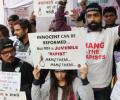
Here are edited excerpts from Dravida Munnetra Kazhagam's Kanimozhi's speech during which she pushed for sending the bill to a Select Committee, arguing that further examination was required to decide whether the age for punitive action should be reduced to 16 years from the current level of 18 years.
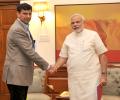
The government's critics say that the Prime Minister failed to rein in vicious and unprecedented personal attacks on the central bank chief by the likes of Rajya Sabha MP Subramanian Swamy.

The government is considering a proposal to privatise some state-owned banks in phases.

BJP president Amit Shah had said during the campaign that the party was fighting the election under Rupani and Nitin Patel.
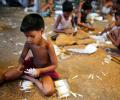
'The Child Labour (Prohibition and Regulation) Amendment Bill' makes employment of children below 14 years as cognisable offence for employers and provides for penalty for parents.

Ushering in the biggest programme in the world to fight hunger, Parliament on Monday gave its nod to the landmark Food Security Bill which seeks to provide highly subsidised foodgrains to the country's two-third population as a right.
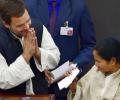
The Trinamool Congress and Nationalist Congress Party, have indicated that their party chiefs have better credentials for the post than the newly-elected Congress head, reports Archis Mohan

The letter, to maintain the current policy of denying Narendra Modi a visa to the United States, was released just as the BJP president arrived in Washington DC for a round of meetings with US lawmakers. Aziz Haniffa reports

The 58-year-old Rajya Sabha MP will face several challenges, including strengthening of the combat capabilities of the army, navy and the air force due to changing regional security matrix and geo-political dynamics.

Honest tax payers need not worry about the new black money law, says finance minister Arun Jaitley.

'You will see how tears again flow from the eyes of this actor 2-3 days before the elections,' he said.

The panel suggested inclusion of alcohol and petroleum products in GST, as is being demanded by the Congress.

Congress has repeatedly alleged a "scam" in the purchase of Rafale fighter jets claiming the cost per aircraft in 2012 was agreed at Rs 526.10 crore while the one signed by the Modi government costs 7.5 billion (Rs 1,670.70 crore per aircraft).
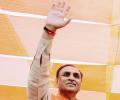
Rupani on Sunday met Governor O P Kohli and staked claim to form the government, a day after he was elected by BJP legislators to succeed Anandiben Patel.
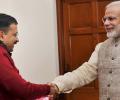
In a jolt to the AAP government, President Pranab Mukherjee has refused to give assent to a legislation that protects 21 party MLAs, who have been appointed parliamentary secretaries, and face the prospect of disqualification.

'Coupled with e-filing procedures it would really enhance the ability of the judiciary to provide speedier justice.'

'Modi's idea of India is to make it less liberal, less tolerant and a less accommodative of diversity.' 'We are headed, if Modi continues, to become an ill liberal democracy.' 'Modi is not Vajpayee. Vajpayee was fundamentally decent, tolerant and fair. He played by the rules of the game. Modi is a different story.'
While its performance in Bihar, has boosted fund collections, corporate contributors are still waiting to see its performances in Assam, Kerala, Tamil Nadu and West Bengal before committing funds to the Congress.

'The farm bills will not bring in corporate zamindari'

Congress gets into the opposition groove but still has miles to go, says Saroj Nagi.

A landmark bill to replace the collegium system of judges choosing judges was on Thursday passed in the Lok Sabha after government dropped a controversial provision that required unanimity in recommendation if the President seeks reconsideration.

More and more Congressmen are breaking their silence and coming out in the open blaming party vice president Rahul Gandhi for the poll drubbing. Renu Mittal reports.
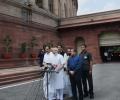
The calculated playing up of confidence by Amit Shah and his team obviously means that the BJP has a strong counter-strategy in place to turn the tables on the Congress before the monsoon session is over, reports Sheela Bhatt/Rediff.com.
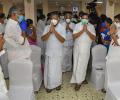
The fracas between Chief Minister Edappadi K Palaniswami and his deputy O Panneerselvam on Monday over who will be projected as the CM candidate in next year's assembly polls not only points to a possibility of another vertical split in Tamil Nadu's ruling party but will also come as sweet music for the opposition DMK which in the past stood to gain from the AIADMK's squabbles, says N Sathiya Moorthy.

Indian cricket, it seems, pays overwhelming obeisance to a vapid, old adage: The more it changes, the more it remains the same.

Rs 200-cr burden likely for TV rating agencies.

Narendra Rawat, an 'arrest-happy' Congress leader, is expected to launch a fair amount of political tamasha against his rival, Narendra Modi, in Vadodara.

Trinamool leaders have claimed the NRC process and subsequent verification is vote bank politics. Other critics call it as modified ethnic cleansing. But putting poll rhetoric aside, the issue dates back to a time when many of these leaders had no political relevance.

The bill would prohibit unaccounted money from being pumped into the sector and as now 70 per cent of the money has to be deposited in bank accounts through cheques.
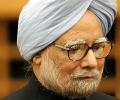
Dr Manmohan Singh's role in the sordid saga of the Coal Allocation Scam was always Delhi's worst-kept secret; calls for his interrogation will mushroom after he was named by P C Parakh, says T V R Shenoy.
 © 2026 Rediff.com - Advertise with us - Disclaimer - Privacy Policy - Sitemap - Feedback - About us - Terms of use - Grievances